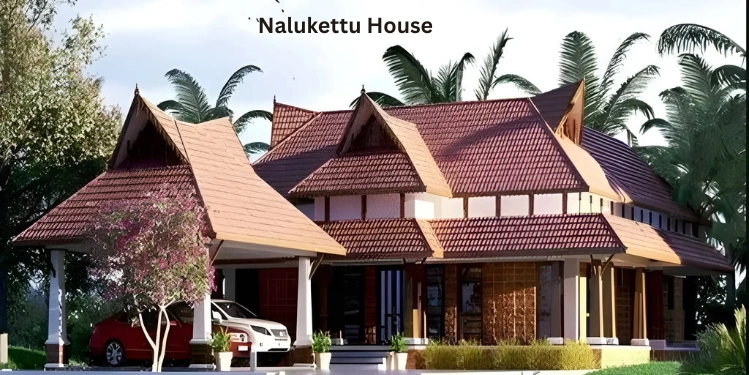
Walk through the arched wooden gateway of a nalukettu house and you step into one of India’s most sophisticated vernacular architecture traditions a design that solved humidity, heat, and privacy challenges centuries before air conditioning existed.
The word nalukettu means “four buildings joined” in Malayalam nalu (four) + kettu (tied together). The four wings (pakuthis) surround a roofless central courtyard called the nadumuttam, which acts as the home’s natural lung: pulling in light, expelling heat, and channeling rainwater into underground cisterns.
Quick Stats: Nalukettu House
| Feature | Details |
|---|---|
| Property Name | Nalukettu House |
| Style | Traditional Kerala courtyard architecture |
| Typical Plot Size | 10–25 cents (400–1,000 sq. m) |
| Built-up Area | 2,500–6,000 sq. ft. (standard) |
| Number of Wings | 4 (North, South, East, West) |
| Central Feature | Nadumuttam (open courtyard) |
| Primary Material | Teak, laterite stone, clay tiles |
| Construction Cost (2025) | ₹2,500–₹4,200 per sq. ft. |
| Heritage Classification | Protected under Kerala’s Heritage Conservation Act |
| Best Location for Ownership | Thrissur, Palakkad, Kozhikode districts |
| Resale Value Trend (2024–25) | +18–22% appreciation for restored properties |
Disclaimer: The information provided in this article about the nalukettu house is based on publicly available records, verified architectural surveys, heritage documentation, and published media sources. Construction costs, property values, and material prices mentioned are approximate figures gathered from market reports and industry sources as of 2025–2026 and may vary based on location, plot size, contractor, and material availability.
Origins & Cultural Ownership: Who Built These Homes?
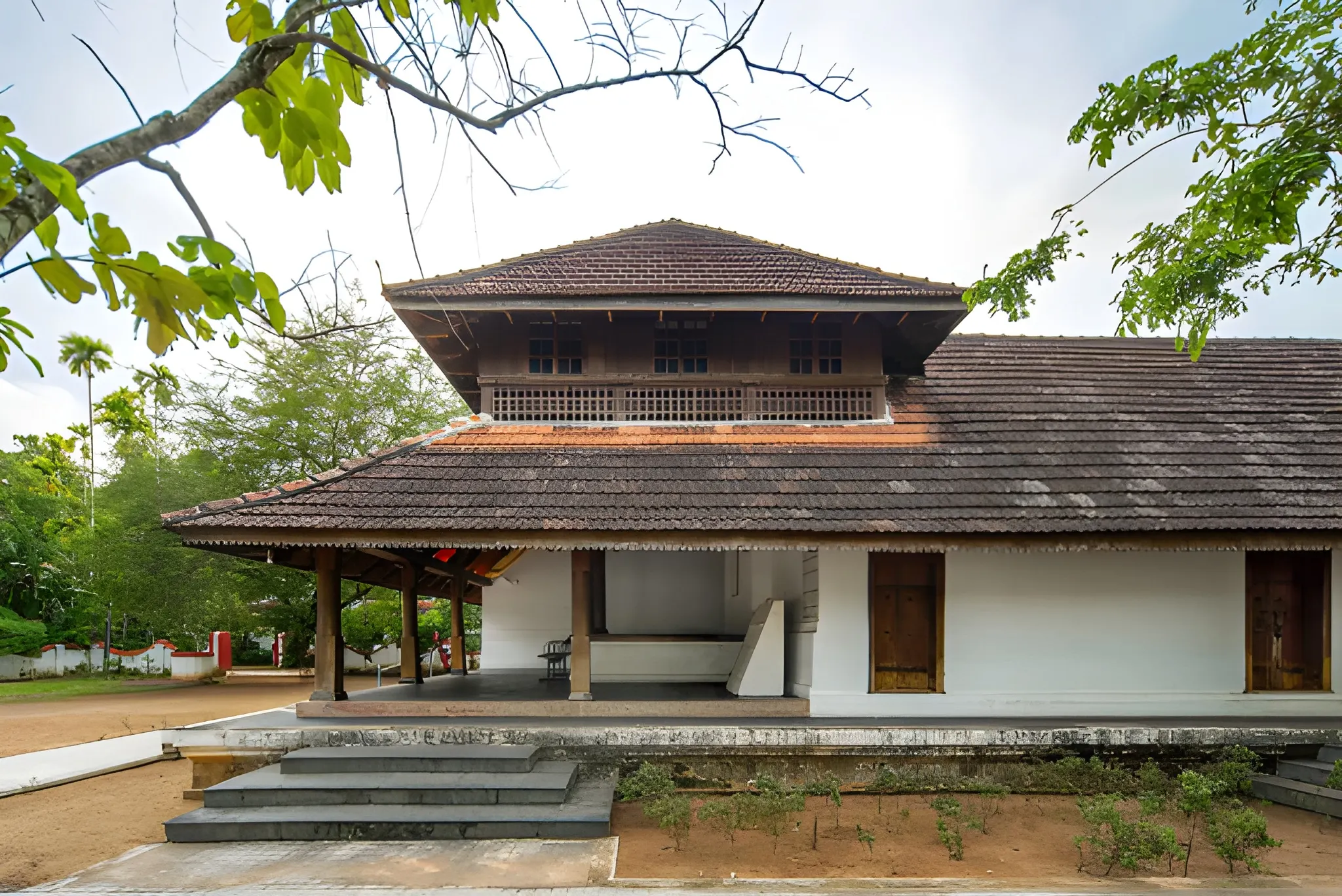
The traditional nalukettu house was historically the domain of prosperous Nair and Namboothiri families across central Kerala, particularly in the districts of Thrissur, Palakkad, and Malappuram. Construction followed Thachu Shastra the Kerala school of carpentry science with master craftsmen called Tachans directing every joint, pillar, and beam angle.
The oldest documented nalukettu structures still standing date to the 15th–16th century. Paliam Nalukettu in Chendamangalam (Ernakulam district), for instance, has been continuously inhabited for over 400 years and is now listed under the Kerala Council for Historical Research’s 2023 heritage documentation project.
What made these homes remarkable was their social architecture. The structure was divided by function: the vadakkini (north wing) served as the prayer and ancestral space, the thekkini (south wing) housed the kitchen and women’s quarters, the east wing welcomed guests, and the west wing served as the men’s sleeping hall.
Location & Property Value: What Does a Nalukettu Cost Today?
Finding an authentic kerala nalukettu house for sale is increasingly rare and expensive.
In 2024–2025, verified sales data from Kerala’s registration department shows:
- Restored heritage nalukettu in Thrissur rural ₹85 lakh to ₹1.8 crore (depending on plot size and condition)
- Urban nalukettu-style new construction in Kozhikode ₹1.2 crore to ₹2.5 crore
- Partial nalukettu (ettu kettu style) in Palakkad ₹55 lakh to ₹90 lakh
Land adjacent to authenticated heritage nalukettu properties in Thrissur and Palakkad districts appreciated by 18–22% between 2023 and 2025, according to local real estate reports published by the Kerala Real Estate Regulatory Authority (RERA Kerala, 2025).
New-construction nalukettu house design projects in towns like Guruvayur, Kunnamkulam, and Ottappalam are seeing a surge, with young homeowners investing ₹60–₹80 lakh for contemporary interpretations that retain the central courtyard but integrate modern amenities.
Architecture & Exterior: How the Structure Works
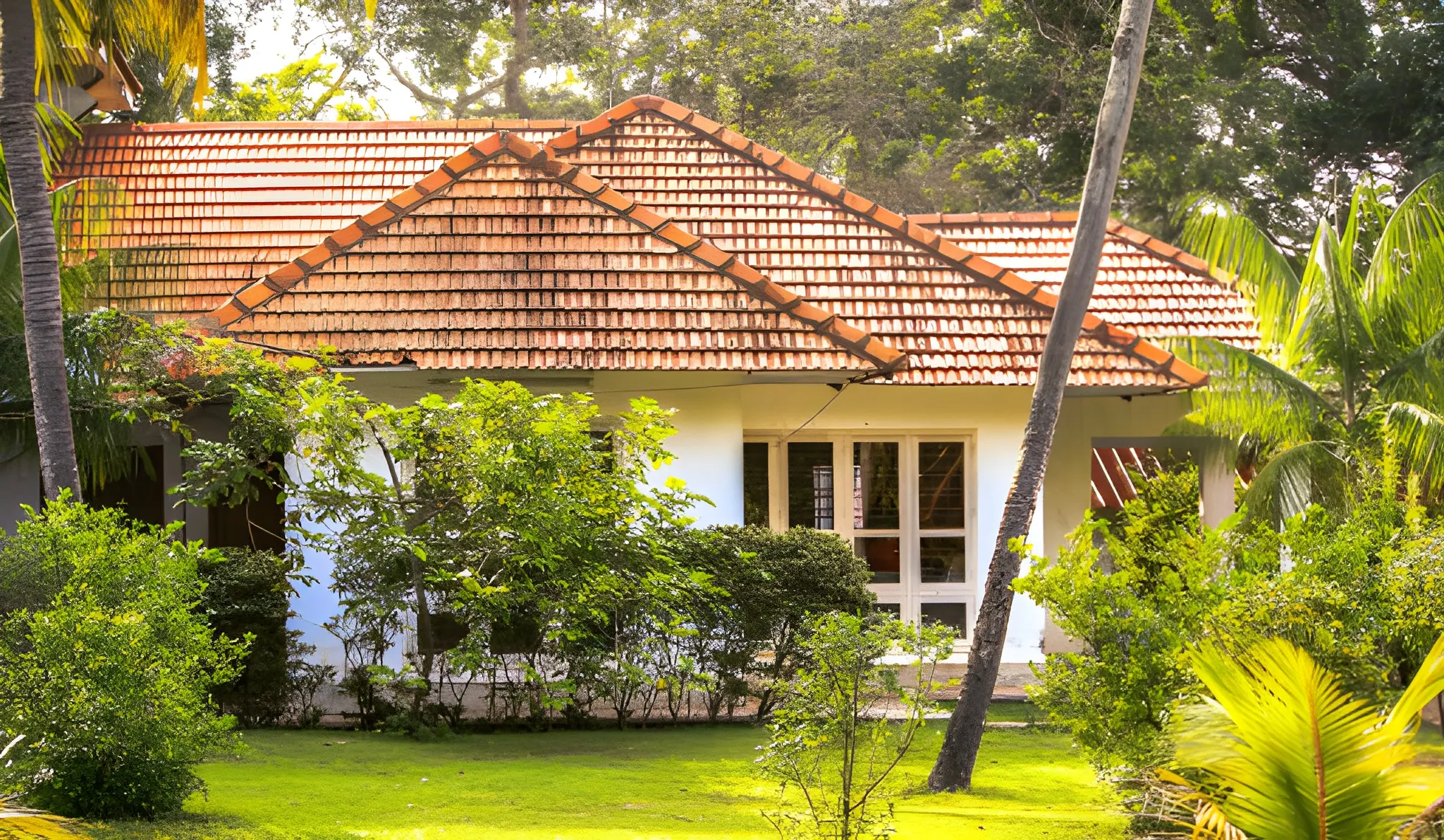
The genius of the nalukettu house design is structural honesty. Nothing is hidden. Every beam, every column, every joint is visible and intentional.
The Four Wings (Pakuthis)
Each wing is a rectangular hall (sala) with a sloping tiled roof that drains inward toward the courtyard. The roofs are typically made of Mangalore clay tiles, set at a 35–45 degree pitch to manage Kerala’s intense monsoon rainfall (average 300 cm annually in the Western Ghats belt).
The exterior walls traditionally built from laterite blocks quarried locally are thick (45–60 cm), which insulates the interior naturally. Laterite stone also has low thermal conductivity, meaning the walls absorb daytime heat but release it slowly after sunset, keeping interiors 4–6°C cooler than outside temperatures even without mechanical cooling.
The Gateway (Padippura)
The entrance structure, called padippura, is often the most decorated element of the exterior. It features:
- Multi-tiered tiled roof with carved wooden brackets (thoolikas)
- Carved teak doors with brass fittings, often engraved with lotus or elephant motifs
- Raised plinth (typically 45–90 cm), which kept floodwaters out during monsoon
The Courtyard (Nadumuttam)
This is the architectural heart. The nadumuttam is deliberately left open to the sky typically 10×10 ft to 20×20 ft and serves as:
- Ventilation shaft: Rising hot air creates convective cooling throughout all four wings
- Light well: Diffused natural light reaches every interior corridor without direct glare
- Rainwater harvesting: Channels carved into the courtyard floor direct water to underground kinar (wells)
- Sacred space: A tulsi (holy basil) plant or small temple structure is traditionally placed at the courtyard center
Interior Design: Stepping Inside the Nalukettu House
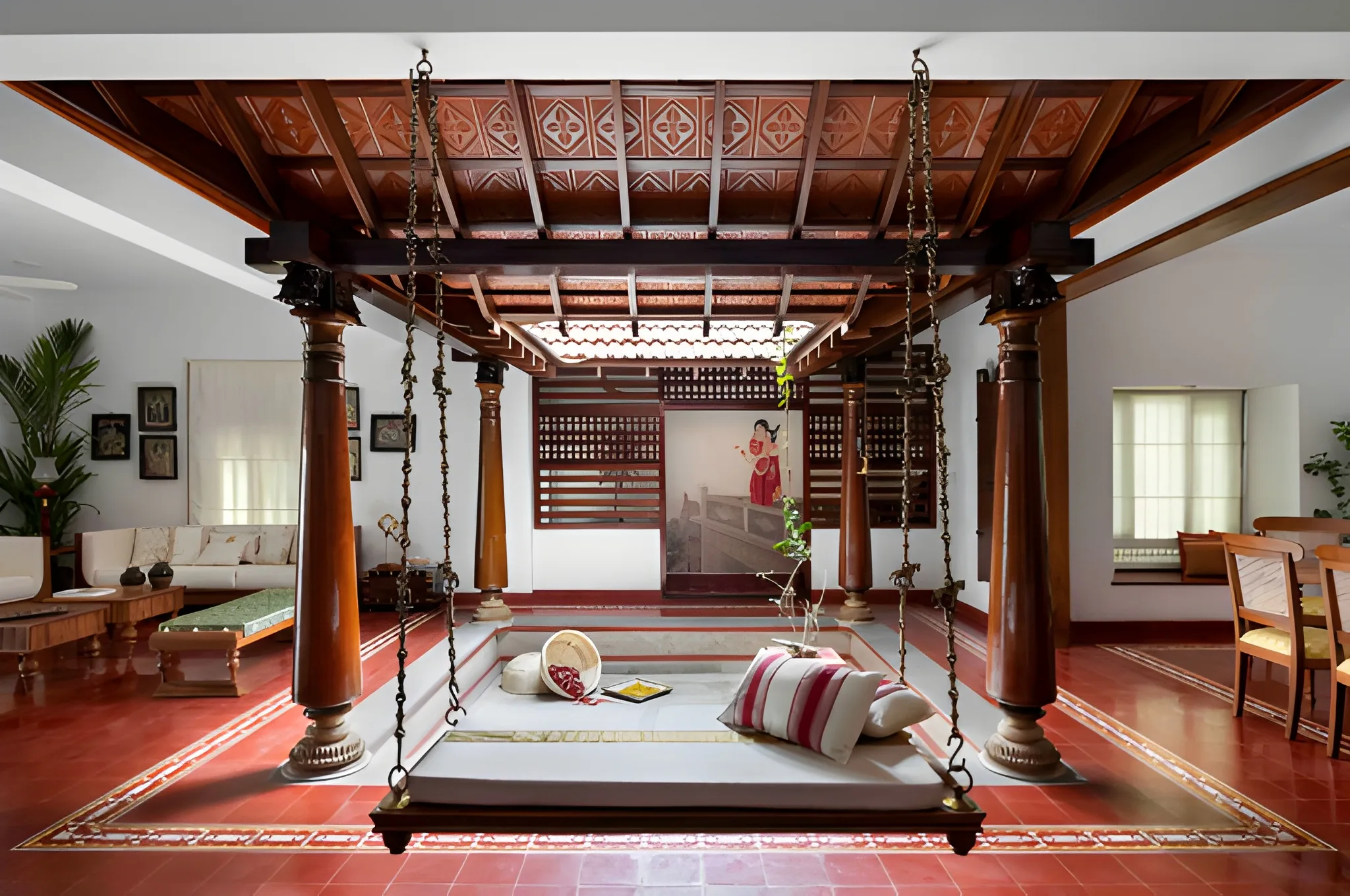
Modern nalukettu house interiors walk a careful line between heritage preservation and contemporary living and the best examples do it without compromise.
The Thalam (Main Hall)
The central hall connecting all four wings is called the thalam. In traditional homes, floors here are finished in lime-oxide polish (chunnambu) a blend of burnt shell lime, egg white, and coconut water, burnished to a mirror-like shine. This surface is antibacterial, cool underfoot, and lasts 50+ years with minimal maintenance.
- Teak panel ceilings with recessed LED strips
- Antique bronze lamps (nilavilakku) repurposed as accent lighting
- Handwoven cotton curtains in natural ivory or indigo to frame the courtyard view
Woodwork: The Soul of the Space
No element defines modern nalukettu house interior design more than its woodwork. Kerala teak (Tectona grandis) is dense, pest-resistant, and takes carvings with extraordinary precision.
Typical interior wood elements include:
- Thulasikattu — carved wooden screen panels separating rooms without blocking airflow
- Thattinpuram — a raised wooden sleeping loft (mezzanine) in the main hall
- Padippadi — carved wooden staircases with turned balusters
Restoration architects working in 2024–2025, including the Kochi-based firm Vaastu Heritage Studio, note that reclaimed teak sourced from demolished older structures commands a 30–40% premium over new plantation teak but produces historically authentic results that newer wood cannot replicate.
Kitchen (Adukkalayidam)
Traditional kitchens were positioned in the thekkini (south wing) for ventilation reasons the south wind carries smoke away from living spaces. Original kitchens featured:
- Wood-fired clay stoves (aduppu) set into raised masonry platforms
- Granite grinding stones embedded in the floor
- Overhead smoke vents carved into the gabled roof
Modern interpretations of the kerala nalukettu house kitchen retain the tiled roof and open-shelf storage aesthetic while integrating modular cabinetry, induction cooktops, and under-counter refrigeration.
Low Cost Modern Nalukettu House: Is It Achievable?
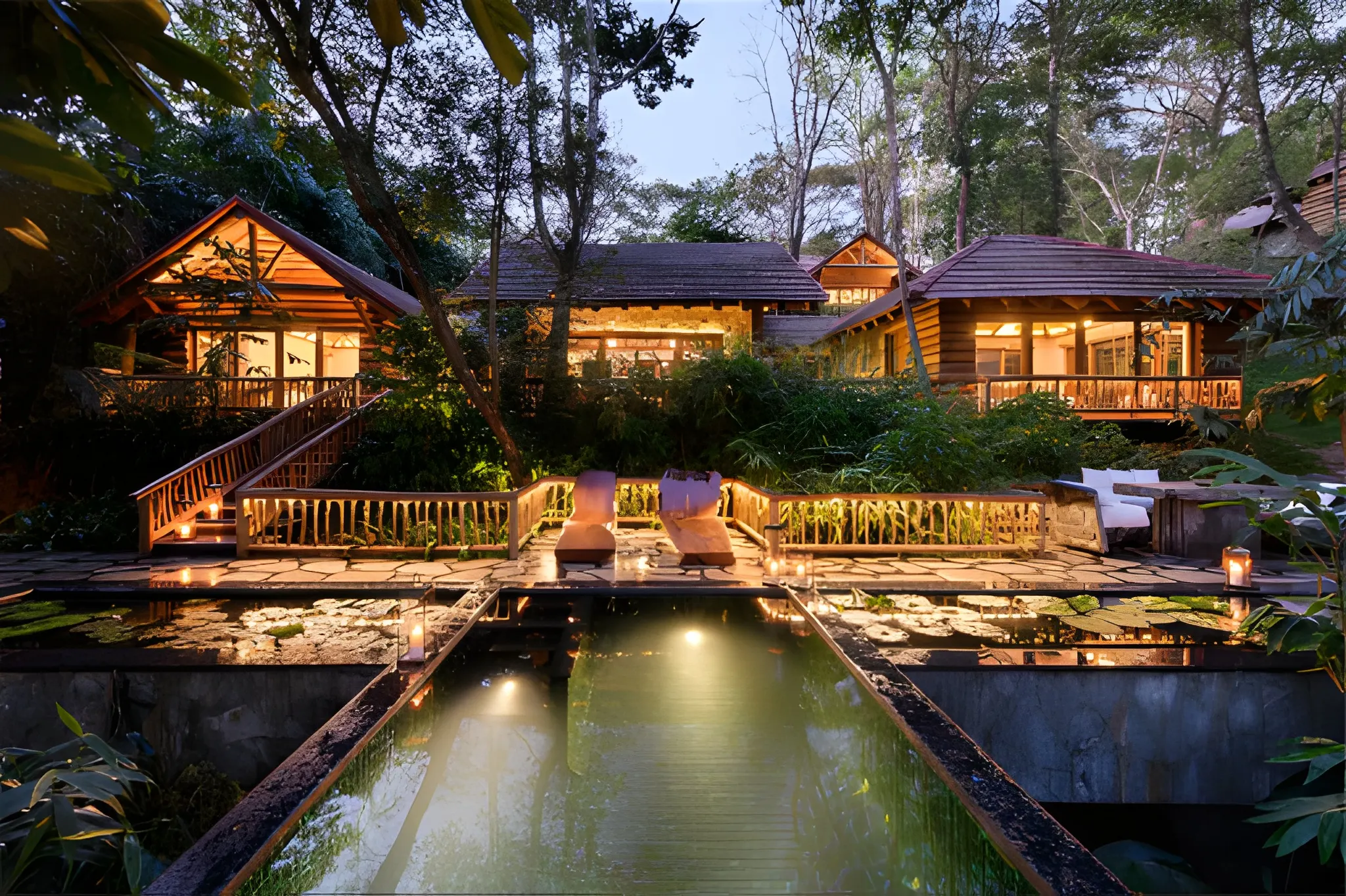
This is the question most homeowners actually want answered and the honest answer is: yes, but with specific trade-offs.
A low cost modern nalukettu house interior project (targeting ₹35–50 lakh total construction including interiors) is achievable if you:
- Reduce the built-up area to 1,800–2,200 sq. ft. (a compact two-wing or modified four-wing layout)
- Use stabilized earth blocks (CSEB) instead of laterite for walls reduces masonry cost by 20–25%
- Source plantation teak or Anjili wood for doors and windows instead of forest teak
- Keep the nadumuttam proportionally smaller (8×8 ft is viable for compact plots)
- Use micro-cement oxide flooring as a cost-efficient alternative to traditional lime-oxide polish
The most significant cost driver in any nalukettu house plan is the woodwork. Experienced craftsmen (Tachans) charge between ₹600–₹1,200 per sq. ft. for carved work and this cost has risen sharply since 2022 due to skilled labor shortages in Kerala’s heritage construction sector.
Budget-conscious builds that skip ornate wood carving but retain structural wood elements (columns, beams, door frames) can achieve the nalukettu aesthetic at genuinely accessible price points.
Nalukettu House Plan: Key Design Considerations
A well-executed nalukettu house plan begins with the relationship between the plot, the cardinal directions, and the courtyard proportion.
Orientation Rules
Thachu Shastra prescribes specific orientation guidelines that modern architects still follow because they have measurable climate benefits:
- East-facing entrance morning light enters the prayer space; the home “wakes” with the sun
- South wing as kitchen prevailing south-west monsoon winds carry cooking smoke outward
- North wing as prayer/ancestor room most sheltered from afternoon heat
- West wing as sleeping quarters afternoon shade from the west roof overhang
Roof Slope & Overhang
The roof overhang (odampu) extending 3–5 ft beyond the outer wall is non-negotiable in genuine nalukettu construction. It protects the thick laterite walls from direct rain penetration which, in Kerala’s 5–6 month monsoon season, is genuinely structural, not decorative.
Architects working on contemporary nalukettu house design adaptations for urban plots often face the challenge of preserving this overhang on constrained sites. The standard solution is a split-level overhang that reduces the horizontal projection while maintaining rain protection through steeper pitch.
What Sets the Nalukettu Apart: Design Trade-offs Most Skip
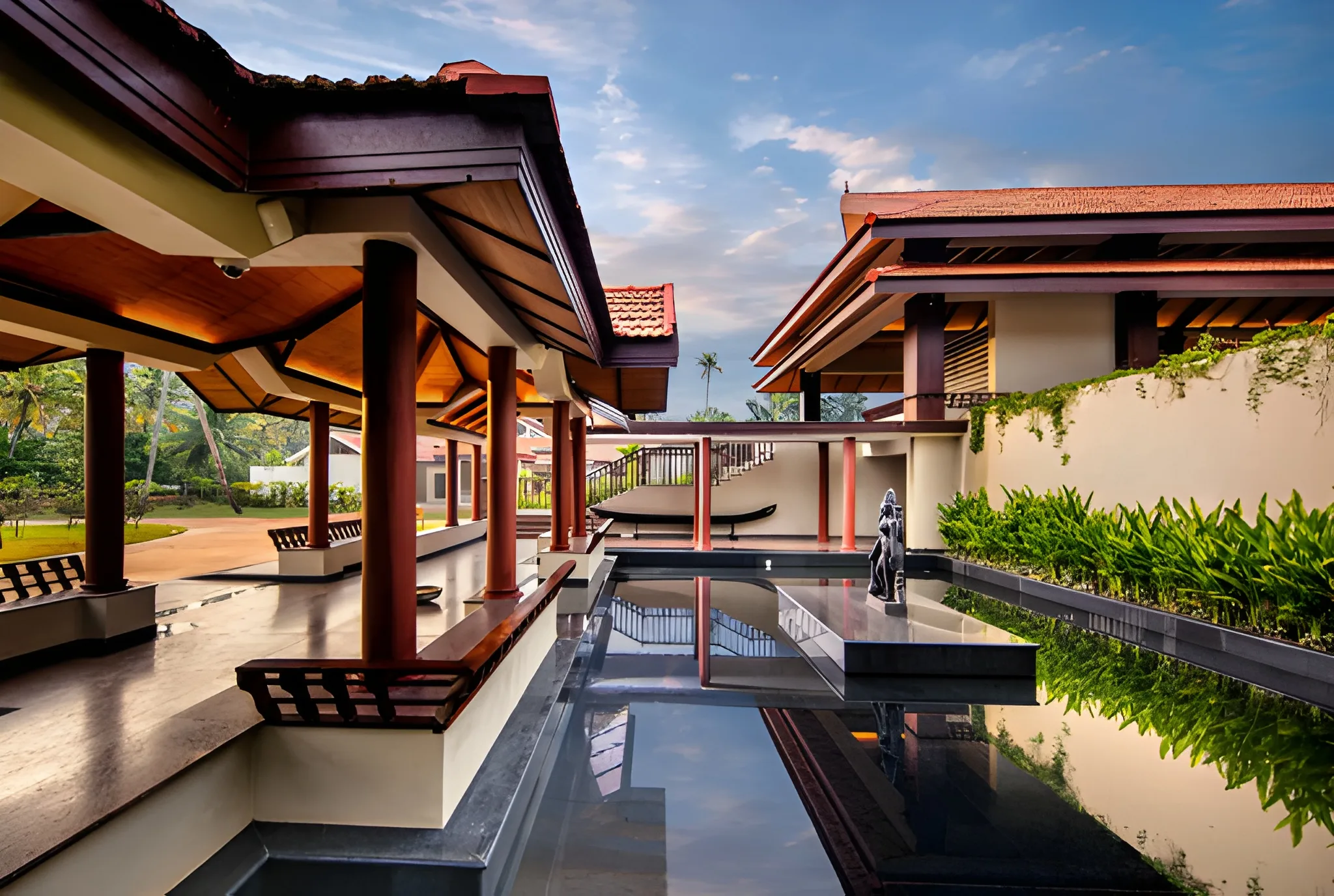
The Strengths You Already Know: Natural cooling, heritage value, stunning visual richness, exceptional resale appreciation.
The Trade-offs Worth Knowing:
| Consideration | Reality |
|---|---|
| Maintenance | Teak woodwork requires oiling every 2–3 years; tiles need annual repointing in high-rainfall zones |
| Open courtyard in cities | Mosquito management becomes critical; mesh screens over the nadumuttam are now standard |
| Skilled labor scarcity | Certified Thachu Shastra craftsmen are concentrated in Thrissur and Palakkad; sourcing them for projects in Thiruvananthapuram or Kochi adds 15–20% to timber work costs |
| Space inefficiency | The four-wing layout “wastes” 12–18% of built-up area to circulation corridors a genuine cost per sq. ft. concern on tight budgets |
| Resale outside Kerala | Appreciation is Kerala-specific; selling to buyers unfamiliar with the form can be harder than selling a conventional villa |
Being clear about these realities helps homeowners make better decisions particularly those comparing the nalukettu house plan against contemporary villa designs of similar budget.
Expert Perspective: What Architects Say
Ar. Divya Menon, a Thrissur-based restoration architect with 14 years of experience in traditional Kerala construction, notes:
“The biggest mistake buyers of old nalukettu homes make is underestimating the restoration budget. A structurally sound 80-year-old nalukettu that looks good on the surface may need ₹25–40 lakh in wood replacement, foundation reinforcement, and waterproofing before it’s genuinely habitable by modern standards.”
The National Institute of Advanced Studies in Architecture (NIASA), in its 2024 survey of Kerala vernacular housing, documented that fewer than 3,200 intact nalukettu structures remain in Kerala down from an estimated 12,000 in 1980. This scarcity is now driving both preservation interest and property value appreciation simultaneously.
Public Reaction & Cultural Moment
Kerala tourism’s “Heritage Home Stay” initiative which certified 340 nalukettu and similar vernacular properties as tourism accommodation by December 2024 generated ₹47 crore in revenue in FY 2024–25, according to Kerala Tourism Board data. The average per-night rate for a heritage nalukettu homestay now sits between ₹4,500 and ₹18,000 depending on location and restoration quality.
On social media, the hashtag NalukettuHome has accumulated over 340 million views on YouTube Shorts and Instagram Reels as of early 2026 driven largely by before-and-after restoration videos that showcase the transformation of neglected heritage homes into stunning contemporary residences.
Architecture influencers like Kochi-based content creator @designwithkerala (590K followers as of February 2026) have noted the nalukettu’s surge in younger audiences: “The courtyard house concept resonates with Gen Z for the same reason it resonated with our great-grandparents it feels human-scaled and honest.”
Read Also: Narain Niwas Palace
Conclusion
The nalukettu house is not a trend. It is a solution to heat, to monsoon, to the human need for beauty in shelter that Kerala’s builders arrived at through centuries of iteration. The open courtyard that seems extravagant is doing structural work. The thick walls that seem heavy are the insulation. The carved wood that seems ornamental is the joinery.
What makes modern nalukettu house interior design so compelling in 2025 is precisely that it refuses to choose between the past and the present. The best contemporary nalukettu homes in Kerala today place an induction cooktop next to a hand-carved teak column, hang a 65-inch screen in a hall lit by a brass oil lamp, and collect rainwater in a computerized tank beneath a 400-year-old courtyard blueprint.
FAQs
Q: What is a nalukettu house?
A: A traditional Kerala home with four wings built around an open central courtyard (nadumuttam), designed for natural cooling and ventilation.
Q: Where is a nalukettu house typically found?
A: Mainly in central Kerala Thrissur, Palakkad, Malappuram, and Ernakulam districts.
Q: How much does a nalukettu house cost in 2025?
A: New construction runs ₹90 lakh–₹1.6 crore for ~3,000 sq. ft. Compact builds start from ₹35–55 lakh.
Q: Can a nalukettu house work on a small urban plot?
A: Yes. Architects adapt it to two wings (ettu kettu) or cover the courtyard with polycarbonate for urban sites.
Q: Who designs nalukettu houses today?
A: Specialists like Vaastu Heritage Studio (Kochi), Mana Architects (Thrissur), and COSTFORD (Thrissur) are leading names.
Q: Is a nalukettu house hard to maintain?
A: Moderate upkeep teak needs oiling every 2–3 years and roof tiles need annual repointing in high-rainfall areas.